

Quality built into the pipeline, not bolted on before release.
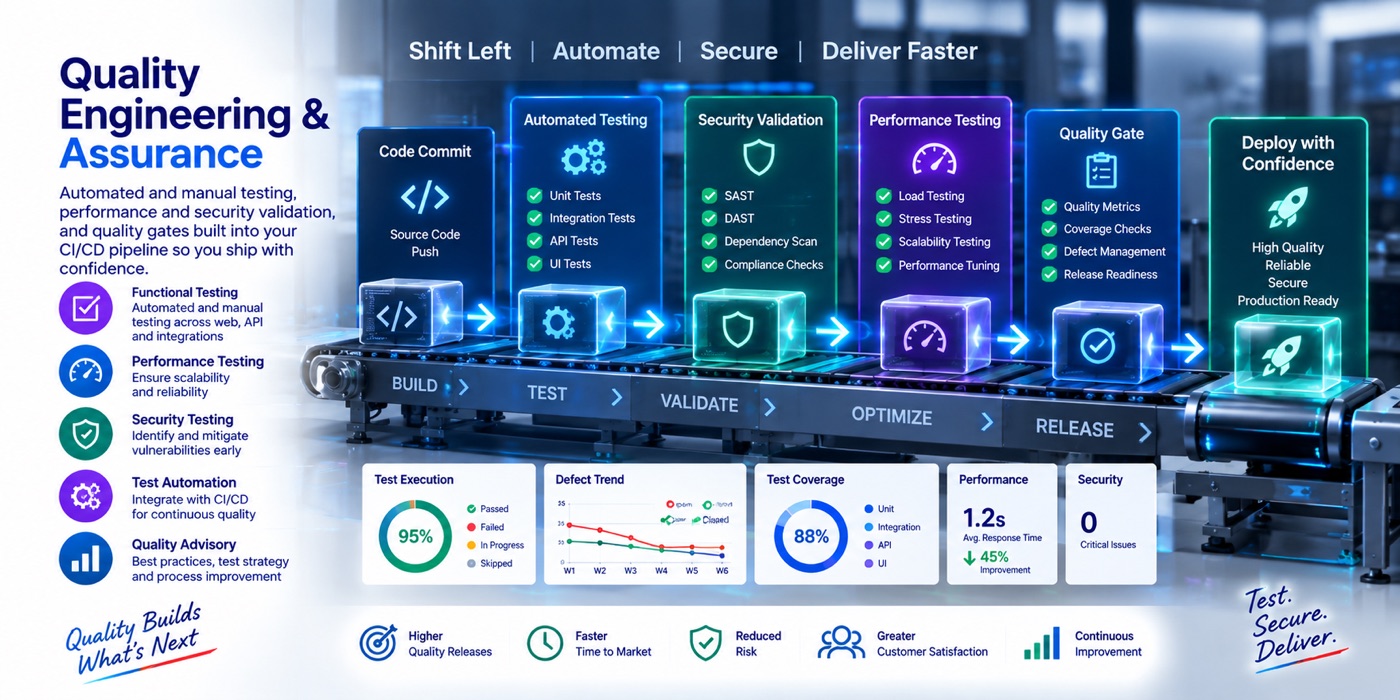
ProSer Insights provides test strategy, automation frameworks, performance and API testing, accessibility and security testing, and UAT management — as an embedded quality engineering practice inside your team, or as an independent verification and validation partner your stakeholders can trust. We test our own production platforms the same way.
Built for teams that ship often and cannot afford to ship broken.
Testing at the end of a release is a bottleneck. Quality engineering moves it into the pipeline, where every change is checked automatically and humans spend their time on the risks that matter. We work with three kinds of teams.
Product teams releasing weekly or faster
who need automated regression, API and end-to-end suites in CI, and a release gate that gives a yes or no in hours, not days.
Enterprises and agencies needing independent verification
where the evaluator, auditor, or program office wants an IV&V partner separate from the development vendor — with traceability, evidence, and formal test reports.
Teams modernizing systems with no tests
who need characterization tests around legacy behavior before anything changes, and a modern automation framework for what replaces it.
Every layer of quality, or just the one you are missing.
Two groups of services. Each ends with a concrete deliverable — a suite running in your pipeline, or a report an auditor will accept.
Strategy & functional
Test strategy & QE assessment
Where defects come from, what is tested and how, what is automated, how long a release takes — and a plan to change it: the test pyramid, tooling, environments, data, and ownership.
Deliverable
QE assessment report and a test strategy your engineering leads have signed.
Manual & exploratory testing
Risk-based exploratory testing, new-feature verification, and cross-browser/device checks by testers who read the requirement and the code change, not just the script.
Deliverable
Test charters, session notes, and defect reports with reproduction steps and evidence.
Test automation — web, mobile, API
Playwright or Cypress for the UI, Postman/Newman or REST-assured for APIs, Appium for mobile — built as a maintainable framework with page objects, data builders, parallel runs, and reporting, wired into GitHub Actions or your CI.
Deliverable
Automation framework in your repository, running in CI, with coverage and flake reports.
UAT management
Planning, scripts, participant coordination, defect triage, and sign-off tracking for user acceptance — the phase most likely to slip when nobody owns it.
Deliverable
UAT plan, scripts mapped to requirements, daily triage log, and signed acceptance.
Specialized
Performance & load testing
k6, JMeter, or Locust scenarios against realistic data volumes; bottleneck analysis across application, database, and infrastructure; and tuning recommendations engineers can act on.
Deliverable
Performance test report with p95/p99 against targets and a prioritized tuning list.
Security testing
OWASP Top 10 application testing, dependency and container scanning, authentication and authorization checks, and retesting after fixes — coordinated with our cyber security practice for full penetration tests.
Deliverable
Security test report with severity-ranked findings and retest evidence.
Accessibility testing (WCAG 2.1 / Section 508)
Automated scans plus manual keyboard, screen-reader, and color-contrast testing; VPAT/ACR preparation for public-sector and enterprise procurement.
Deliverable
Accessibility audit, remediation guidance, and an ACR your buyer will accept.
Data & reporting validation
Row counts, reconciliation, transformation logic, and report-figure validation for migrations, data warehouses, and compliance reports — where a wrong number is a finding, not a bug.
Deliverable
Validation workbook with reconciliation results and signed test evidence.
Automation engineers who understand the product. Test managers who understand the auditor.
- 1
We test our own production systems.
TimeFlow HR's approval workflows and append-only audit trail, ProSer VoiceAI's conversation flows and human handoff — our regression, performance, and accessibility suites run against them every release. What we sell is what we use.
- 2
Engineers, not click testers.
Our QE team writes code: Playwright and Cypress frameworks, API contract tests, k6 scripts, CI integration. Manual testing is deliberate and exploratory, not a substitute for automation that was never built.
- 3
Public-sector and compliance fluency.
Requirements traceability matrices, IV&V deliverables, Section 508 and WCAG audits, formal test plans and reports in the formats state and federal programs expect.
- 4
US and India delivery, one accountable lead.
A US-based test lead owns strategy and reporting; the India team runs overnight regression and automation build, so a release tested at end of day in the US is reported on before the morning stand-up.
Open, standard tools your team can keep.
- UI & mobile — Playwright, Cypress, Selenium, Appium; cross-browser grids and device clouds.
- API & contract — Postman/Newman, REST-assured, Pact; schema and contract tests in CI.
- Performance & security — k6, JMeter, Locust; OWASP ZAP, dependency and container scanning.
- Accessibility & management — axe, NVDA/VoiceOver, Lighthouse; Jira/Azure DevOps/TestRail traceability; GitHub Actions and Azure Pipelines.
From assessment to a release gate you trust.
The lead who assesses your process builds the strategy and stays through delivery, so the gate reflects your real risks.
Set up
Week 0–1
QE assessment
Defect sources, current coverage, release timeline, environments, and tooling reviewed with your engineers.
Week 1–2
Strategy & plan
Test pyramid, tooling decisions, environments and data, ownership, and metrics agreed.
Week 2–4
Framework & CI
Automation framework scaffolded in your repository and running in your pipeline with reporting.
Sprints
Automation build
Regression, API, and end-to-end suites built against a prioritized backlog; flaky tests fixed, not skipped.
Run
Each release
Regression gate
Automated suites plus targeted exploratory testing; go/no-go report within hours.
Cycles
Performance & security
Scheduled load and security test cycles, with retests after fixes.
Milestones
UAT & acceptance
Scripts, participants, triage, and signed acceptance for major releases.
Monthly
Metrics & handover
Coverage, escaped defects, cycle time, and flake rate reported; knowledge transfer to your team.
Priced the way you release.
Project-based testing
A scoped engagement — a release, a migration, a performance or accessibility cycle — with a fixed fee and a defined report.
Best for: one-off milestones and independent verification.
Scope a projectEmbedded QE pod
A dedicated test lead and automation engineers inside your sprint cadence on a monthly retainer, owning the regression gate and the automation backlog.
Best for: product teams releasing continuously.
Talk about a podStaff augmentation
Automation engineers, performance testers, accessibility specialists, and test managers placed with your team, onshore or offshore, through our staffing practice.
Best for: teams with a process who need capacity.
Request profilesWhat the work looks like.
Government contractor · Timekeeping platform
Audit-trail and approval-workflow test suite
Built automated regression for timesheet, leave, and approval flows and validated the append-only audit trail and Excel/PDF exports for a DCAA-style review.
Healthcare · Voice AI deployment
Conversation regression and handoff testing
Designed scenario-based tests for booking, reschedule, and escalation paths, including handoff to human agents, and load-tested concurrent call handling.
State agency · Case management system
UAT management and Section 508 testing
Ran user acceptance for a multi-agency rollout, with a requirements traceability matrix, accessibility audit, and formal test reports for the program office.
Questions we get before a QE engagement.
Manual or automated?+
Both, deliberately. Automation covers regression, APIs, and the critical paths on every build; people do exploratory testing, new-feature verification, usability, and the accessibility checks a scanner cannot. The strategy says which is which.
Which tools will you use?+
Yours, if you have a standard; otherwise open tools your team can keep — Playwright or Cypress, Postman, k6, axe — in your repository and CI. We do not lock you into a proprietary platform.
Can you be independent from our development vendor?+
Yes. For IV&V we report to the program owner, not the developer, with our own environments, traceability, and formal test reports.
Can you test AI applications?+
Yes. We build evaluation sets and scenario tests for conversational and LLM-based features — accuracy, containment, handoff, and regressions across prompt or model changes — drawing on how we test ProSer VoiceAI.
What scale can you performance-test to?+
Cloud-based load generation lets us simulate thousands of concurrent users or calls. We test against realistic data volumes and report p95/p99 against targets you set.
How will we know it is working?+
Escaped defects, regression cycle time, automation coverage, and flake rate — reported monthly against the baseline from the assessment.
Related services and products
Have a release you need confidence in?
Tell us how you release today and what breaks. Within two business days you will have a QE assessment outline, a first-cut strategy, and a fixed quote.