

Modernize the systems your business runs on — without stopping the business.
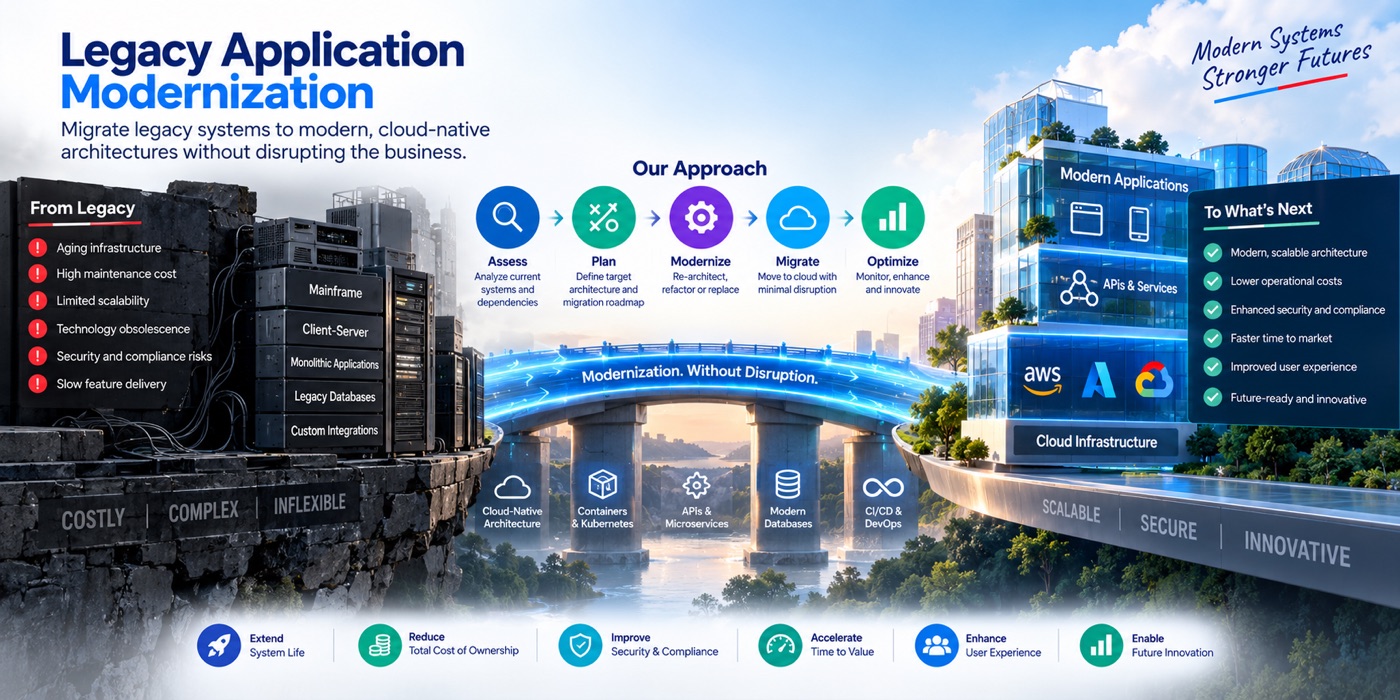
From AngularJS and jQuery front ends to monoliths, stored procedures, and on-prem databases, ProSer Insights assesses, plans, and executes modernization in increments: React and NestJS rewrites, API-first re-platforming, PostgreSQL migrations, and containerized deployment with CI/CD. Every slice ships to production and pays for the next.
Built for organizations whose critical systems have outlived their stack.
Modernization fails when it is treated as a rewrite project with a launch date. It works when it is treated as a series of production releases, each retiring a piece of the old system. We work with three kinds of teams.
Companies with aging web applications
on AngularJS, Angular 2–10, jQuery, ASP.NET WebForms, or PHP — where every change is slow, hiring is hard, and the security scanner keeps flagging the framework version.
Agencies and regulated organizations
with on-prem systems, custom databases, and compliance obligations that make a big-bang migration unacceptable. We plan for audit, data retention, and continuity from the start.
Product companies slowed by technical debt
whose release cadence, cloud bill, or on-call load is the symptom of an architecture that no longer fits. We re-platform while the roadmap keeps shipping.
Assess honestly. Then modernize in slices that each go live.
Two groups of services. Each ends with a concrete deliverable — a decision you can defend, or code running in production.
Assess & plan
Portfolio & application assessment
Inventory of applications, frameworks, dependencies, integrations, and owners; code and database health; security exposure; and a rehost / re-platform / rewrite / retire recommendation for each.
Deliverable
Assessment report with a scored disposition per application and a risk register.
Target architecture
The end state — front-end framework, API layer, data platform, authentication, hosting, observability — chosen for your team's skills and constraints, not for fashion.
Deliverable
Architecture pack with diagrams, technology decisions and rationale, and non-functional targets.
Roadmap & business case
Waves of work sequenced by value and risk, with effort estimates, staffing, cost-of-delay, and the run-cost comparison your CFO will ask for.
Deliverable
Phased roadmap, estimate with assumptions, and a business case in your finance team's format.
Data migration planning
Schema mapping, data-quality profiling, cleansing rules, reconciliation approach, and the dual-run or cutover strategy for each database.
Deliverable
Data migration plan with mapping workbook and reconciliation tests.
Execute
Front-end modernization
Angular, AngularJS, jQuery, and WebForms UIs rebuilt in React (or the framework you have standardized on), component by component, reusing existing HTML and CSS assets where they are sound so users see continuity, not disruption.
Deliverable
Production React front end, component library, and retired legacy modules per release.
API & backend re-platforming
Monoliths and stored-procedure logic exposed behind versioned APIs — NestJS/Node or .NET Core — using a strangler façade so old and new run side by side until the last route is switched.
Deliverable
API layer with contract tests, façade routing rules, and decommission checklist.
Database migration
Oracle, SQL Server, MySQL, or Access to PostgreSQL or a managed cloud database, with migration-based schema management (TypeORM/Flyway-style) so every change is repeatable and reviewable.
Deliverable
Migrated database with reconciliation report, rollback plan, and migration scripts under version control.
Cloud, containers & CI/CD
Containerization, environment parity, GitHub Actions pipelines, secrets management, hardened hosts, monitoring and alerting — so the modernized system is also easier to run.
Deliverable
Pipelines, infrastructure as code, hardened deployment target, and operations runbook.
A team that has migrated its own stacks — and kept the lights on while doing it.
- 1
Incremental by design.
We use strangler façades, feature flags, and dual-running to replace systems a module at a time. Each release retires something old and is reversible if it must be. No 18-month rewrite with nothing to show.
- 2
We have done the specific migrations.
Angular-to-React migrations that preserved existing HTML/CSS to ease the transition; monolith logic re-platformed to NestJS and PostgreSQL; desktop applications packaged with bundled databases; deployments moved to GitHub Actions on hardened hosts.
- 3
Delivery engineering, not just code.
CI/CD, environments, observability, and server hardening are part of every modernization, because a modern application on a fragile deployment path is not modern.
- 4
US and India delivery, one accountable lead.
A US-based architect owns the roadmap and the cutovers; the India team gives you sustained build capacity, so modernization runs alongside the roadmap instead of replacing it.
A target stack we run in production ourselves.
- Front end — React and TypeScript, component libraries, accessibility built in; Angular supported where you are standardized on it.
- Back end — NestJS/Node.js and .NET Core APIs, versioned contracts, background jobs, and event-driven integration.
- Data — PostgreSQL first, with migration-based schema management; managed cloud databases where they fit.
- Platform — Containers, GitHub Actions, infrastructure as code, hardened Ubuntu hosts or your AWS/Azure/GCP, with monitoring and backups from day one.
From inventory to decommission — with production releases in between.
The architect who assessed the portfolio leads the build, and the roadmap is re-planned after every wave with what was learned.
Assess
Week 0–2
Discovery & inventory
Applications, integrations, data flows, owners, and pain points; access to code and environments.
Week 2–4
Assessment & target state
Code and data health, security exposure, disposition per application, target architecture.
Week 4–6
Roadmap & business case
Waves, estimates, staffing, run-cost comparison — reviewed with engineering and finance.
Execute
Sprint 0
Foundations
Pipelines, environments, observability, façade routing, coding standards — before the first slice.
Sprints
Strangler slices
Modules rebuilt and released behind the façade; legacy routes retired one by one.
Rehearsals
Data migration dry runs
Timed migrations against production copies with reconciliation until the numbers match.
Cutover
Switch & verify
Final migration, traffic switched, smoke and reconciliation tests, rollback ready.
Close
Decommission & handover
Old systems retired, licenses cancelled, documentation and runbooks handed to your team.
Priced for the shape of the work.
Fixed-price assessment
A 4–6 week assessment of one application or a whole portfolio, ending in a scored disposition, target architecture, and roadmap with estimates.
Best for: deciding what to do before committing budget.
Scope an assessmentModernization squad
A dedicated team — architect, front-end and back-end engineers, QA, DevOps — on a monthly retainer, delivering roadmap waves with a named US-based lead.
Best for: multi-application programs or a large system replaced in slices.
Talk about a squadStaff augmentation
React, NestJS/.NET, database, and DevOps engineers placed with your team, onshore or offshore, through our staffing practice.
Best for: teams with an architecture and plan who need capacity.
Request profilesWhat the work looks like.
Enterprise · Customer-facing web application
Angular-to-React migration without a visual reset
Migrated the front end to React component by component, holding existing HTML/CSS assets so users saw no disruption while the legacy framework was retired.
Software vendor · Desktop product
Electron desktop application with bundled PostgreSQL
Re-packaged a desktop application with an embedded database, CI packaging via electron-builder, and resolved a compounding series of authentication issues.
Nonprofit · Web platform rebuild
React, NestJS, and PostgreSQL platform with admin panel and payments
Rebuilt the platform with an admin panel for content, events, and donations, migration-based schema workflows, and a Razorpay payment integration scoped to a settings table.
Questions we get before a modernization.
Should we rewrite or refactor?+
Usually neither in full. The assessment scores each application for rehost, re-platform, rewrite, or retire. Most portfolios end up as a mix, and most single applications are best replaced module by module behind a façade rather than rewritten in one go.
How do you avoid a big-bang cutover?+
Strangler façades, feature flags, dual-running databases, and reconciliation testing. Users move to new modules progressively; the final switch is small and rehearsed, with a rollback that has been tested.
Will we lose data or customizations?+
No. Data migration is profiled, mapped, rehearsed, and reconciled before cutover. Customizations are inventoried in the assessment and either rebuilt, replaced by configuration, or consciously retired with the business owner's sign-off.
Can you work with our existing team?+
Yes, and we prefer it. Your engineers know the system; we bring the method and capacity. We pair, review, and document so your team owns the result.
There are no tests and little documentation. Is that a problem?+
It is normal. We write characterization tests around the legacy behavior before changing it, and document as we go — the assessment itself produces the first real architecture documentation many systems have had.
How long does it take?+
An assessment takes four to six weeks. Modernization waves typically run in three-to-six-month increments, each with production releases. The roadmap gives you dates per wave, re-planned after each one.
Related services and products
Have a system that is holding you back?
Tell us what it runs on and what it costs you. Within two business days you will have an assessment outline, a first-cut disposition, and a fixed quote for the assessment.