
Data that is available, recoverable, and where it should be.
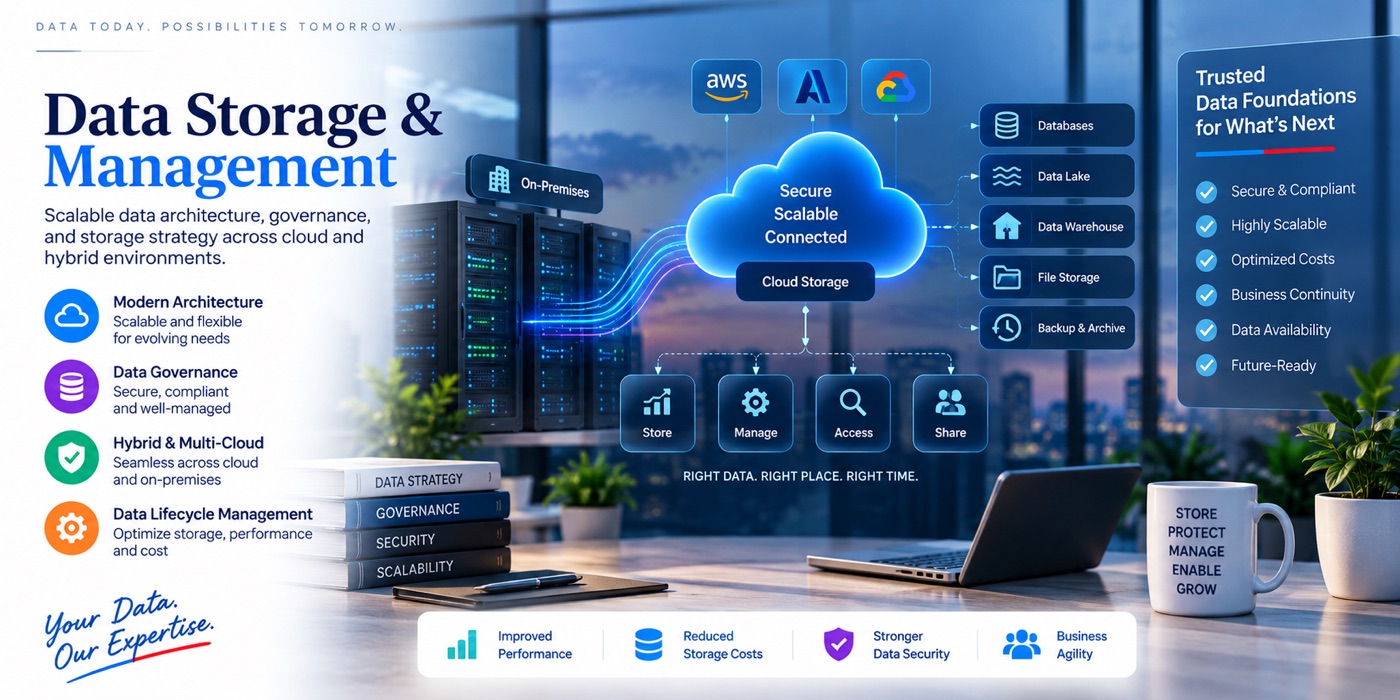
ProSer Insights designs, migrates, and operates the data layer your applications depend on: database architecture and administration (PostgreSQL first, also SQL Server, MySQL, MongoDB), backup and disaster recovery that is actually tested, storage architecture on-prem and in the cloud, and the retention, residency, and access policies regulators ask about.
Built for organizations whose data outgrew the people looking after it.
The database is the one component that cannot be redeployed from a repository. It needs design, care, and a recovery plan someone has rehearsed. We work with three kinds of teams.
Companies running critical databases without a DBA
where developers tune queries when they can, backups are assumed to work, and nobody has restored one lately.
Organizations migrating platforms
from Oracle, SQL Server, or on-prem hardware to PostgreSQL or managed cloud databases — needing schema conversion, data migration, reconciliation, and a cutover with a rollback.
Regulated organizations with retention and residency rules
in healthcare, government contracting, or finance — where what is kept, for how long, where, and who can see it are audit questions.
Design it. Run it. Move it. Govern it.
Two groups of services. Each ends with a concrete deliverable — a measured recovery time, a migrated system with reconciliation evidence, a policy that is enforced.
Design & operate
Database architecture & design
Schema design and review, indexing and partitioning strategy, high availability and read scaling, connection management, and migration-based schema workflows so every change is repeatable and reviewed.
Deliverable
Architecture and schema design pack with capacity plan and change workflow.
Administration & performance tuning
Query and index tuning, configuration, vacuum and maintenance, upgrades, monitoring and alerting, capacity tracking — as a health check or ongoing managed service.
Deliverable
Health-check report with prioritized fixes; monthly performance and capacity report under managed service.
Backup, disaster recovery & high availability
Backup strategy with defined RPO/RTO, point-in-time recovery, off-site copies, replication and failover, and scheduled restore drills that prove the plan works.
Deliverable
DR plan, implemented backups and replication, and drill reports with measured recovery times.
Storage architecture & capacity
Block, file, and object storage design on-prem and in the cloud; tiering, lifecycle, and encryption; capacity forecasting so growth is planned rather than discovered.
Deliverable
Storage architecture, lifecycle policies, and a 24-month capacity forecast.
Move & govern
Database & storage migration
Oracle, SQL Server, MySQL, or Access to PostgreSQL; on-prem to managed cloud; file shares to object storage — with schema conversion, rehearsed migrations, reconciliation, and rollback.
Deliverable
Migrated system with reconciliation report and rollback evidence.
Archival, retention & lifecycle
Retention schedules mapped to legal and contractual requirements, archival tiers, legal hold, and defensible deletion — with the audit trail that shows the policy was followed.
Deliverable
Retention schedule, implemented lifecycle rules, and deletion evidence procedure.
Governance, residency & access
Data classification, encryption at rest and in transit, role-based and row-level access, audit logging, and residency controls for US and India processing.
Deliverable
Data governance framework with classification, access matrix, and audit logging.
Cost optimization
Right-sizing instances and storage, tiering cold data, consolidating databases, and choosing managed versus self-hosted by workload — with the run-cost comparison before and after.
Deliverable
Cost analysis and implemented savings with a before/after report.
Engineers who run PostgreSQL in production and treat backups as a test, not a checkbox.
- 1
We run our own data estate.
TimeFlow HR and ProSer VoiceAI run on PostgreSQL with replication, continuous archiving, and restore drills. Migration-based schema management — TypeORM and versioned SQL — is how we ship every change. We operate what we recommend.
- 2
Migrations rehearsed until the numbers match.
Every migration runs against production copies until reconciliation is clean and the timing is known. Cutover is the least eventful day of the project.
- 3
Compliance-aware by default.
Audit trails, consent-linked retention, encryption, access logging, and residency are designed in, because our clients sell to governments and handle PHI — and so do we.
- 4
US and India delivery, one accountable lead.
A US-based data lead owns architecture and cutover decisions; the India team provides round-the-clock monitoring, maintenance windows, and migration execution.
PostgreSQL first. Your platform where you have one.
- Databases — PostgreSQL (self-hosted, RDS/Aurora, Azure Database, Cloud SQL), SQL Server, MySQL/MariaDB, MongoDB, Redis.
- Backup & HA — pgBackRest/WAL-G, streaming replication and Patroni, point-in-time recovery, cross-region copies.
- Storage — S3/Azure Blob/GCS with lifecycle and encryption; NAS/SAN and on-prem object storage; hardened Linux hosts.
- Tooling — TypeORM/Flyway/Liquibase migrations, pgBadger and query monitoring, Prometheus/Grafana, infrastructure as code.
From health check to a data layer you can lose and recover.
The lead who reviews your estate designs the target and runs the cutover, so decisions made in week one are honored on cutover day.
Stabilize
Week 0–1
Inventory & risk review
Databases, storage, backups, owners, data classes, and compliance obligations catalogued.
Week 1–2
Health check
Performance, configuration, backup validity, replication, security, and cost reviewed with findings ranked.
Week 2–4
Target design
Architecture, HA/DR with RPO/RTO, storage tiers, retention policy, and migration approach agreed.
Sprint 1
Backup & DR implemented
Backups, archiving, replication, and monitoring live; first restore drill run and timed.
Transform
Rehearsals
Migration dry runs
Schema conversion and data migration against production copies until reconciliation is clean.
Cutover
Switch & verify
Timed migration, application repointed, reconciliation and smoke tests, rollback on standby.
Rollout
Governance live
Retention and lifecycle rules, access controls, audit logging, and classification enforced.
Ongoing
Managed operations
Monitoring, maintenance, quarterly restore drills, capacity and cost reporting, upgrades.
Priced for the risk you are retiring.
Health check & DR plan
A fixed-fee review of your databases and storage ending in ranked findings, a DR plan with RPO/RTO, and a costed roadmap.
Best for: knowing where you stand before committing.
Scope a health checkManaged database services
Monitoring, maintenance, backups, restore drills, tuning, upgrades, and on-call on a monthly retainer with defined SLAs and a named lead.
Best for: organizations running critical databases without a DBA.
Talk about managed serviceMigration project
A fixed-scope migration — platform, cloud, or storage — with rehearsals, reconciliation, cutover, and a hypercare period.
Best for: a platform or hosting change with a deadline.
Scope a migrationWhat the work looks like.
SaaS company · PostgreSQL availability
Replication, continuous archiving, and tested recovery
Moved a single-node PostgreSQL to a replicated setup with continuous WAL archiving, automatic failover, and quarterly restore drills with measured recovery times.
Software vendor · Desktop product
Bundled PostgreSQL packaging and upgrade path
Designed database packaging, initialization, and upgrade handling for an Electron desktop application shipping with an embedded PostgreSQL instance.
Enterprise · Platform migration
Oracle to PostgreSQL with dual-run reconciliation
Converted schema and stored logic, migrated data with rehearsed runs and reconciliation, and cut over with a 30-day dual-run and rollback plan.
Questions we get before a data engagement.
Cloud or on-prem?+
Whichever your workload, compliance, and budget call for — and often both. We run hardened self-hosted PostgreSQL and managed cloud databases and will show you the cost and operational trade-offs for your case.
Managed (RDS, Azure Database) or self-hosted?+
Managed services remove patching and backups but cost more and constrain configuration. Self-hosted on hardened hosts is cheaper and more flexible but needs operations — which we can provide. The health check makes the recommendation per database.
How often do you test restores?+
Quarterly at minimum under managed service, and after every material change. A backup that has not been restored is a hope, not a plan — the drill report is the deliverable.
How much downtime will a migration need?+
Usually minutes, occasionally hours, rarely a weekend. Rehearsals tell us the exact number before we schedule the cutover, and dual-running or logical replication can reduce it further where needed.
Can you keep data in a specific region or country?+
Yes. Residency for US and India processing, region-locked storage and backups, and access controls that respect it are part of the governance design.
Do you delete data?+
Only under a written retention policy, with approval and an audit trail. Defensible deletion is a governance deliverable — nothing is removed ad hoc, and every deletion is evidenced.
Related services and products
Not sure your last backup would restore?
Tell us what you run and what worries you. Within two business days you will have a health-check outline, a first-cut risk view, and a fixed quote.